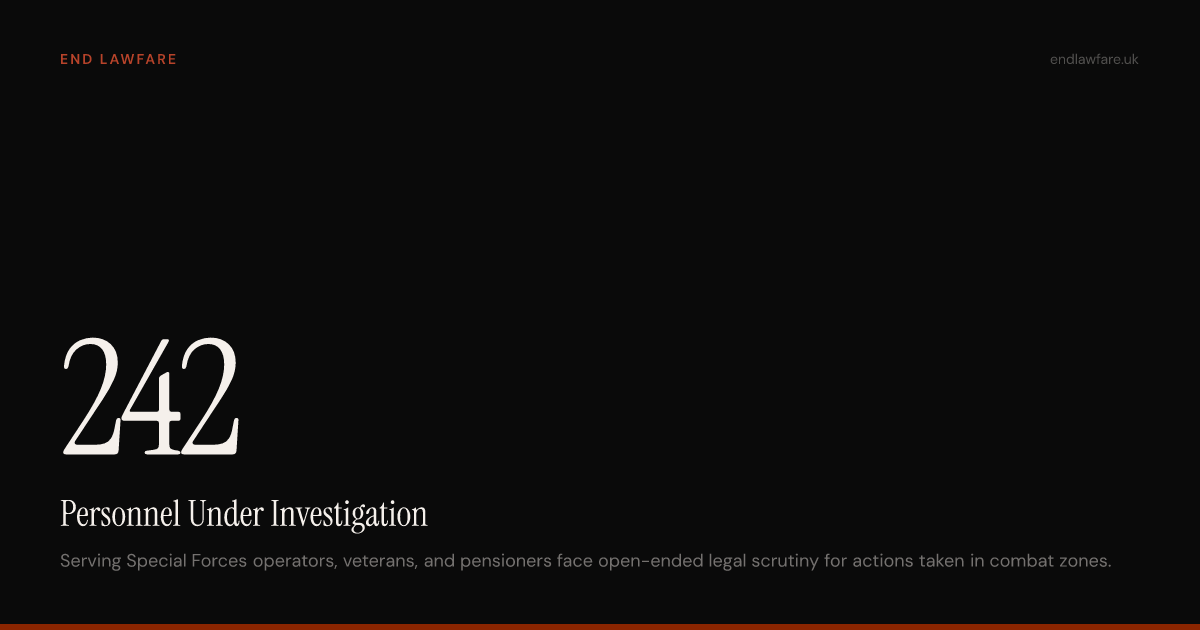
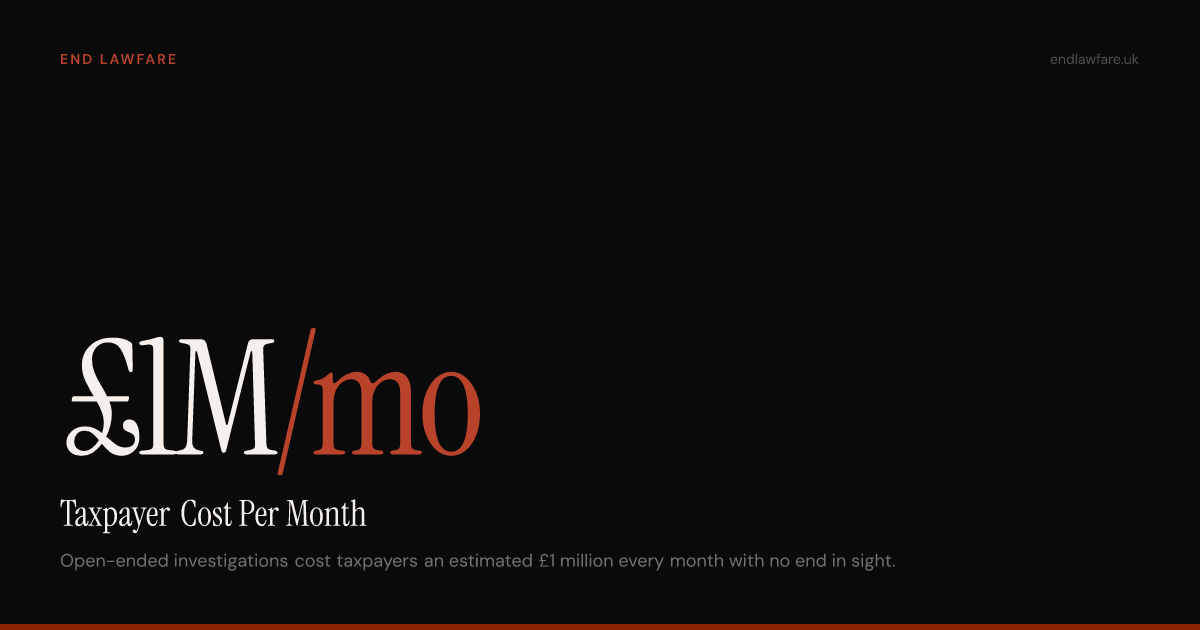
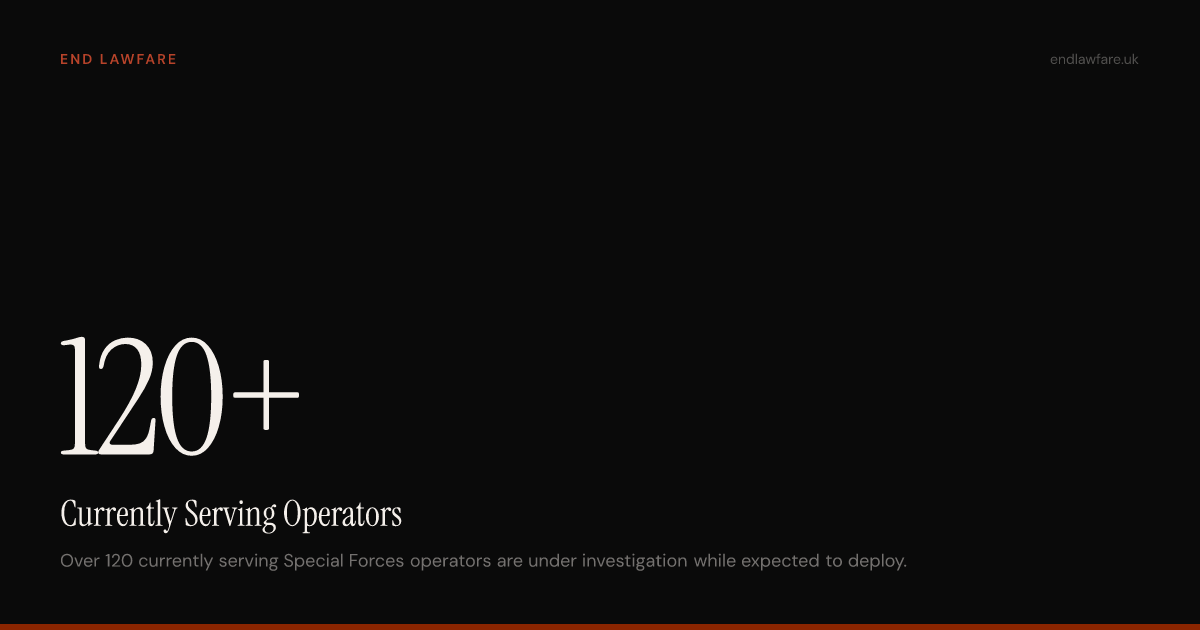
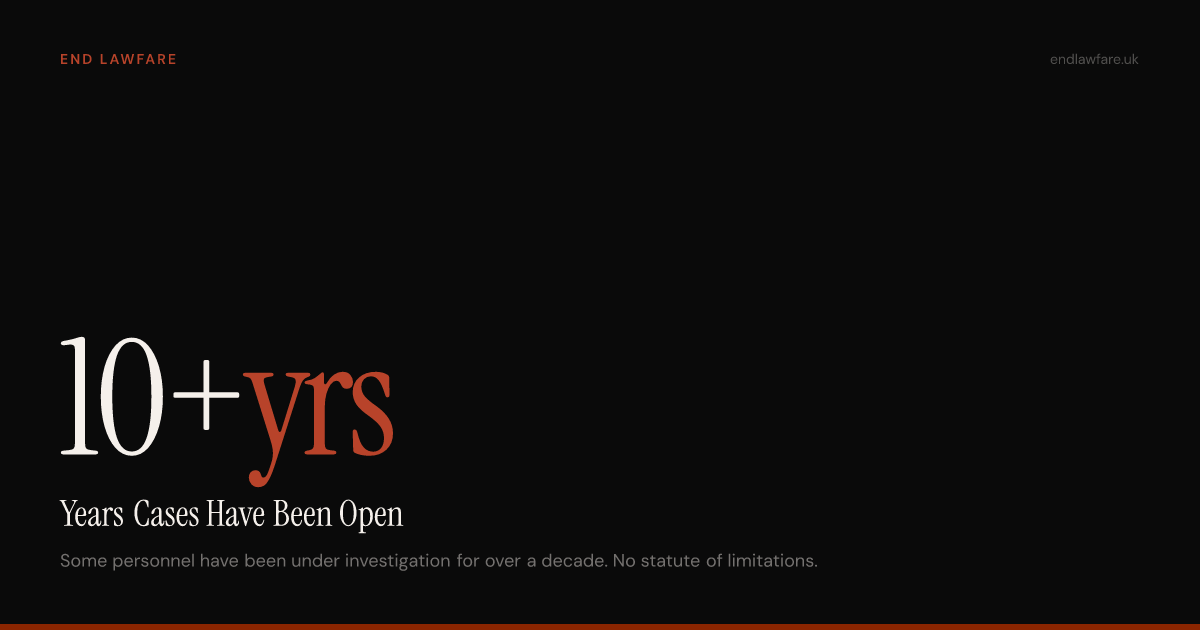
120+ currently serving operators are expected to deploy while under open-ended investigation. Veterans and pensioners face the same scrutiny — some for over a decade — with no end in sight. The process costs taxpayers £1 million a month and is hollowing out Britain's elite capability.
We are calling on MPs to amend the NI Troubles Bill to protect those who served. Write to yours now →
Update · 24 April 2026 Attorney General Lord Hermer referred to the Bar Standards Board over his role in a case against British troops. Read the briefing →
British Special Forces personnel face simultaneous legal campaigns spanning Northern Ireland and Afghanistan. Both share the same structural problem: open-ended processes with no statute of limitations, asymmetric scrutiny, and devastating human cost. The Bill is in committee stage today. Amendments are being tabled this week.
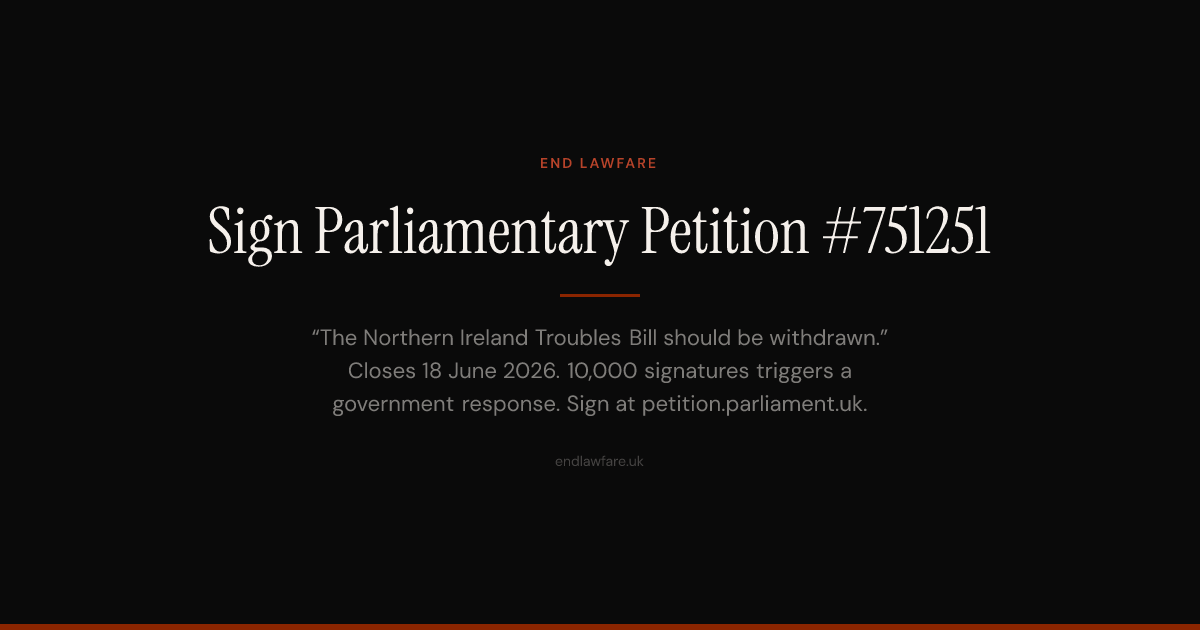
Labour's Northern Ireland Troubles Bill (introduced October 2025, currently in committee) removes the conditional immunity from the 2023 Legacy Act. This re-opens halted inquests, civil claims, and potential prosecutions for pre-1998 actions during Operation Banner. The SAS Regimental Association has taken the unprecedented step of threatening judicial review via Sidley Austin LLP, calling the Bill "manifestly deficient" in veteran protections. Cases like the 1987 Loughgall ambush — involving 24 SAS soldiers — face re-opening.
The Independent Inquiry (est. December 2022) examines alleged unlawful activity by UK Special Forces in deliberate detention operations, mid-2010 to mid-2013. Now in its third year with no final report. In January 2026, the inquiry seized backup drives from a UKSF IT server (ITS1) after the MoD indicated the data was unavailable. Closed hearings use anonymised witnesses — the accused cannot see the full scope of allegations against them.
The Royal Military Police already ran Operation Northmoor — a multi-million-pound investigation into the same Afghan allegations. Northmoor closed due to insufficient evidence for prosecution. The current inquiry is functionally an investigation into the investigation, forcing veterans to defend the same split-second decisions a decade later.
Nine senior generals and former SAS commanders wrote an open letter warning of "an endless spiral of lawfare." Internal memos report two suicide interventions among those under investigation. Recruitment and retention in elite units is in crisis. Commanders warn that troops are second-guessing split-second decisions, and former RSMs describe it as destroying morale from the inside.
Where genuine evidence of wrongdoing exists, proper investigation serves justice and upholds military standards. Some allegations in the Afghanistan inquiry are serious and deserve due process. The issue this site addresses is not accountability itself — it is the asymmetry, the absence of time limits, the cost to national security, and the failure of duty of care. Soldiers who operated under rules of engagement in combat zones should not face decades of open-ended legal scrutiny that those they fought against largely do not. This can be true at the same time as genuine wrongdoing deserving investigation.
Lord Richard Hermer KC — appointed Attorney General in July 2024 — previously acted as lead counsel for eight Iraqi claimants whose allegations against British soldiers were ruled by a public inquiry to be “deliberate lies.” In April 2026, The Telegraph published 25,000+ pages of emails and documents raising serious questions about his conduct of the case. He has been referred to the Bar Standards Board.
The public inquiry led by Sir Thayne Forbes concluded that all the most serious allegations — claims of murder and torture of Iraqi detainees at Camp Abu Naji after the 2004 Battle of Danny Boy — were “wholly without foundation and entirely the product of deliberate lies, reckless speculation and ingrained hostility” towards the British Army. Every British soldier was exonerated of the gravest charges. The inquiry cost the taxpayer approximately £25 million.
Drawing on more than 25,000 pages of contemporaneous emails and documents, The Telegraph reports that Hermer — then at Matrix Chambers, acting on a conditional fee agreement rather than under the cab rank rule — was repeatedly warned of problems with his clients’ accounts and continued to press the case.
In a 2008 email about a draft press release, Hermer is quoted as writing that the proposed wording gave “some wriggle room if the killings did not in fact happen.” On his clients’ credibility, he is reported to have written that it was irrelevant whether his client was “a saint or a member of al-Qaeda.”
Shadow Justice Secretary Nick Timothy has written to the Bar Standards Board, referring Lord Hermer for alleged serious professional misconduct. The letter alleges breaches of the conduct rules on misleading courts, advancing improper claims, and pressing for public money in settlement of allegations known to be false.
Former Attorney General Sir Michael Ellis has said Lord Hermer’s conduct “makes him unfit to be Attorney General.” Brian Wood MC, a Military Cross recipient wrongly accused in the Danny Boy litigation, has publicly called on Lord Hermer to step down.
A spokesman for the Attorney General has said: “Over a 30-year legal career, the Attorney General represented many clients — including British military personnel, such as a British soldier killed by IRA terrorists, and injured servicemen in the Iraq War. Any suggestion that the Attorney acted improperly during his private career is false.”
The spokesman said Lord Hermer was not involved substantially in the Al-Sweady claims after 2008, and that his work on the case amounted to “less than a day’s work” in which he made clear further investigation was needed. No regulatory finding has yet been made against him.
The office of Attorney General requires public confidence in the impartiality of its holder. The 2014 Al-Sweady Inquiry found that the allegations advanced against British soldiers in that case were deliberate lies. The Telegraph’s 2026 reporting raises serious questions about what Lord Hermer knew, and when.
While the Bar Standards Board considers the referral, the same Attorney General is advising the Government on the inquiries and legacy legislation that today bear down on those who served. That is not compatible with fair treatment for British troops.
Lord Hermer should step down. Write to your MP and ask them to say so — publicly, and in the House.
These are real accounts from serving and former Special Forces personnel willing to speak publicly about the impact of open-ended investigations on their lives and careers.
Speaking on the Shawn Ryan Show about being investigated for war crimes and the reality of lawfare facing British Special Forces.
The government claims six protections for veterans in the new Bill. SASRA has proposed 14 specific safeguards. The gap between the two tells the story.
| Safeguard | Government Position | SASRA Position |
|---|---|---|
| Presumption against reinvestigation | No repeated investigations "without new evidence" Vague | Compelling new evidence threshold required; burden of proof on the state Specific |
| Statute of limitations | No time limit proposed Missing | Hard caps on historical investigations, aligned with Overseas Operations Act intent Proposed |
| Conditional immunity | Removed entirely by Remedial Order Reversed | Immunity for actions under lawful orders/ROE, absent compelling contrary evidence Proposed |
| Anonymity in proceedings | Anonymity "options" available Discretionary | Anonymity by default for all veterans in legacy proceedings Mandatory |
| Asymmetry of scrutiny | Not addressed Missing | Equivalent scrutiny for paramilitary actors; no immunity gap Proposed |
| MoD duty of care / legal support | "MoD-supported contact" offered Vague | Fully funded independent legal representation for all investigated personnel Specific |
Every action below is lawful, democratic, and constitutional. The Bill is in committee stage now — this is when amendments are tabled and political pressure matters most.
Enter your postcode to find your MP and generate a personalised letter.
Personalise and send. The template references key facts — the SASRA position, the generals’ open letter, and the 242 figure.
Use the template above. Reference the SASRA position, the generals' open letter, and the 242 figure. Copy in the Defence Select Committee and NI Affairs Committee chairs. The Bill is in committee — amendments are being tabled now.
Use the tool above →The SAS Regimental Association is leading the judicial review threat and running Project Verity. Contact them to offer support, donate, or connect if you have relevant experience or platform.
Visit SASRA →The original “Protect Northern Ireland Veterans” petition reached 209,956 signatures and was debated on 14 July 2025. It is now closed, which blocks a repeat for six months. The successor petition — covering the full 242 figure, Haddon-Cave, and NI legacy — needs to launch the moment the window re-opens. Be ready.
Check petition status →The DSC can summon MoD officials and force answers on the public record. Coordinated pressure on committee members to launch a sub-inquiry into cost, scale, and mental health toll is higher-leverage than writing to a backbencher.
Defence Committee →Forces News, the Spectator, and the Telegraph have covered this story. Tip them the 242 figure and the SASRA judicial review threat. Journalists need leads — give them one.
Forces News contact →Use the share cards above or the quick-share buttons on the hero stats. Every share during committee stage adds pressure. The more people see the numbers, the harder they are to ignore.
Go to share cards →